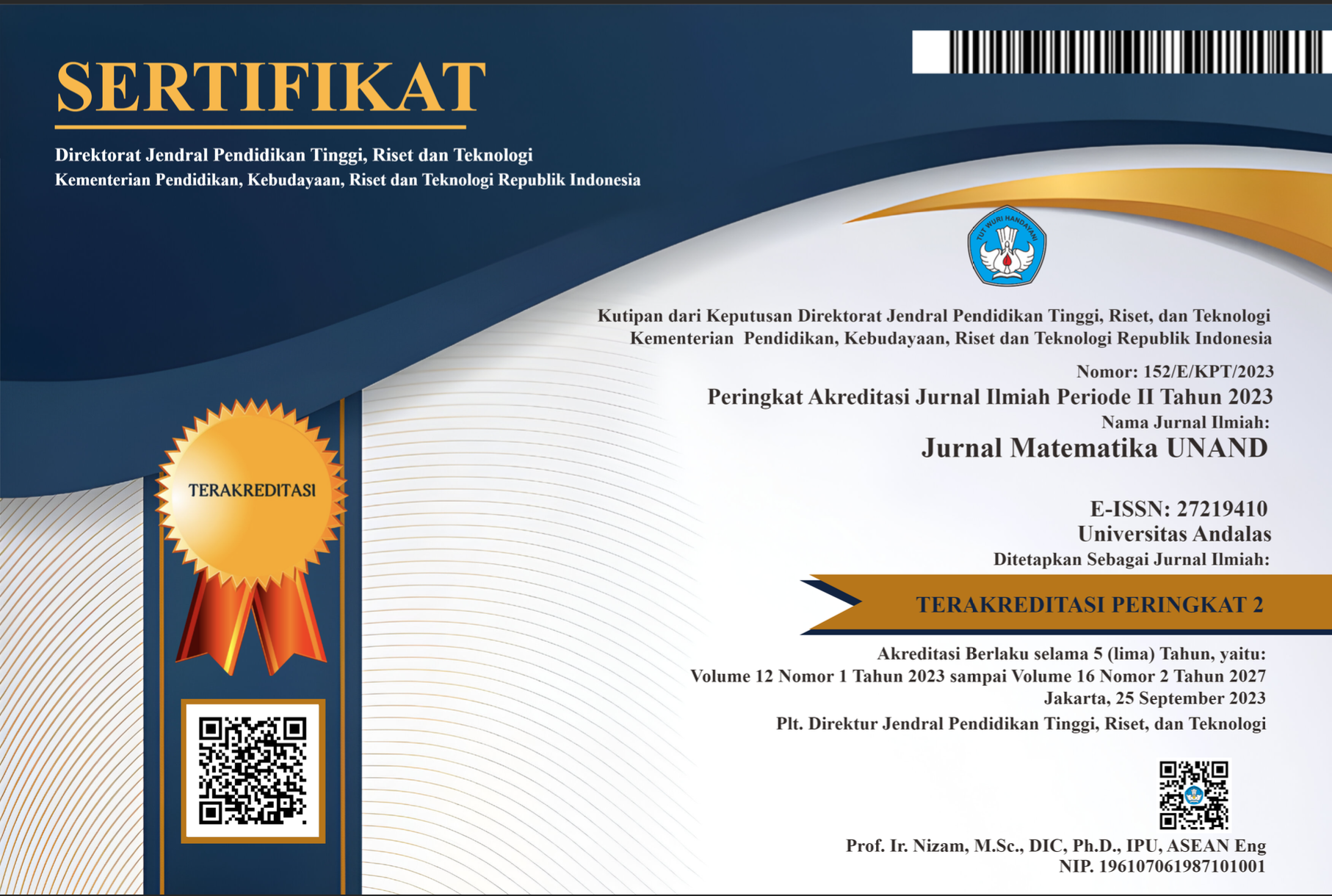
ANALISA FAKTOR PENYEBAB KREDIT MACET DENGAN METODE QUEST
DOI:
https://doi.org/10.25077/jmu.2.2.76-85.2013Abstract
Perkreditan selalu dibutuhkan bagi pengembangan usaha, yaitu oleh pen-gusaha yang tengah mengembangkan usaha maupun pengusaha yang baru akan memulai
usaha. Dalam suatu proses pemberian kredit, kadangkala terdapat kredit macet yaitu
suatu keadaan dimana terjadi tunggakan kredit lebih dari 6 kali masa angsuran. Banyak
faktor yang mempengaruhi kredit macet, analisis statistika yang dapat digunakan adalah
metode QUEST (Quick, Unbiased, Ecient, Statistical Trees). Pada penelitian ini data
yang diambil adalah data nasabah yang mengambil kredit dari tahun 2010 dengan
peubah bebas usia, penghasilan, ukuran keluarga, lama kredit, besar cicilan, besar kredit,
pekerjaan nasabah, dan jenis kredit. Setelah dilakukan analisa dengan metode QUEST
diperoleh faktor yang berpengaruh terhadap kredit macet adalah angsuran dan ukuran
keluarga.
Downloads

Downloads
Published
How to Cite
Issue
Section
License
All articles published in Jurnal Matematika UNAND (JMUA) are open access and licensed under the Creative Commons Attribution-ShareAlike 4.0 International License (CC BY-SA 4.0). This license allows published content to be freely accessed, shared, redistributed, and adapted for any purpose, including commercial use, provided that the applicable license conditions are followed.
Copyright Holder
The copyright of articles published in Jurnal Matematika UNAND is held by the Departemen Matematika dan Sains Data, Fakultas Matematika dan Ilmu Pengetahuan Alam (FMIPA), Universitas Andalas (UNAND), in accordance with the journal's stated copyright policy.
Author Rights
Under the CC BY-SA 4.0 license, authors may share, distribute, and reuse their published articles, subject to the applicable license conditions. These rights include:
-
Self-Archiving: Authors may deposit their published articles in institutional repositories, personal websites, or academic platforms.
-
Reuse: Authors may reuse their published work in subsequent publications, research, teaching materials, or other lawful purposes, provided that appropriate attribution is maintained.
-
Distribution: Authors may share and distribute their published articles without requiring additional permission under the terms of the license.
Creative Commons License (CC BY-SA 4.0)
Under the CC BY-SA 4.0 license, users are free to:
-
Share: Copy and redistribute the material in any medium or format.
-
Adapt: Remix, transform, and build upon the material for any purpose, including commercial purposes.
These permissions are subject to the following conditions:
-
Attribution: Users must give appropriate credit to the original author(s), retain relevant copyright notices, provide a link to the license, and indicate if changes were made. Attribution must not imply endorsement by the author(s), copyright holder, or journal.
-
ShareAlike: If users remix, transform, or build upon the material, they must distribute their contributions under the same CC BY-SA 4.0 license or a compatible license.
-
No Additional Restrictions: Users may not apply legal terms or technological measures that legally restrict others from exercising the rights granted by the license.
For more information about the CC BY-SA 4.0 license, please visit:
https://creativecommons.org/licenses/by-sa/4.0/
Third-Party Content
Third-party materials, including figures, tables, photographs, and illustrations, are covered by the article's CC BY-SA 4.0 license only when their inclusion under that license is authorized.
Materials excluded from the license must be clearly identified with appropriate copyright notices and attribution. Authors are responsible for obtaining any necessary permissions, while users must comply with the applicable licensing terms or permissions when reusing excluded materials.
Copyright and Licensing Information
Copyright and licensing information should be clearly displayed on each published article's landing page and included in the full-text versions (HTML and PDF), where applicable, to ensure transparency regarding copyright ownership and permitted reuse.